
Fayetteville Public Records by Custodian
No universal city search covers every record set. Fayetteville administrative files stay with the city department that made them. Cumberland County offices keep land, tax, GIS, local vital, and estate material. The North Carolina Judicial Branch maintains the statewide court index, while the Cumberland County Clerk of Superior Court supplies local case files and certified copies. This division matters because an open record sent to the wrong office can still yield no result.
| Fayetteville record set | Keeper | Web route | Access channel |
|---|---|---|---|
| Deeds, liens, plats, assumed names | Cumberland Register of Deeds | Records Search, land coverage to 1754 | Free index; paid plain or certified copies |
| District, superior, estate, and judgment files | Judicial Branch and Cumberland Clerk | eCourts Portal | Free public index; terminal, clerk file, or certification |
| Parcels, listed owners, taxes, and maps | Tax Administration and GIS | Current property gateway and prior-bill search | Free web tools; office detail by request |
| Birth, death, marriage, and divorce records | Register of Deeds, NC Vital Records, or Clerk | Ordering information, not one open statewide index | ID, entitlement, and record-specific rules apply |
| City records, permits, and police reports | City department, City Clerk, or Police | NextRequest, permit portals, and P2C | Posted record, portal, kiosk, or focused request |
| State correctional and registry information | NCDAC or State Bureau of Investigation | Official offender and registry searches | Free search within each system's scope |
Online access and legal access are not identical. Some indexes are open while the source image or certified copy must come from a counter or mail request. Sealed and expunged cases, juvenile and adoption matters, protected addresses, confidential investigation material, and specified personal identifiers do not become open merely because an agency stores them in a database.
Chapter 132 and Fayetteville Records
North Carolina Public Records Law covers material made or received by a state or local agency in the course of public business. It reaches paper, maps, photos, recordings, and electronic data. Any requester may inspect covered material at reasonable times and seek copies. The law does not require North Carolina residency or an explanation of the requester's purpose.
The statute says a custodian must provide copies “as promptly as possible.” It sets no universal three-, five-, or ten-day deadline. Volume, storage, redaction, and the office holding the record can affect time. A clear request can describe the subject well enough for staff to locate the material even if the requester does not know an internal file name. The agency need not create a new record, answer a research question, or build a custom database query that does not already exist.
When part of a record is exempt, ask for the remaining portion after protected data are removed. For a denial, request the specific statute used for each withholding. G.S. 132-9 permits civil enforcement, and a requester may seek voluntary pre-litigation mediation through the court program described by the North Carolina Judicial Branch.
Note: “Promptly” is the actual Chapter 132 standard, so Fayetteville request timing turns on the record set and work required.
Fayetteville Deed Records Since 1754
The Cumberland County Register of Deeds Records Search reaches land records back to 1754. That is content coverage, not a claim about when scanning began or whether every old notation appears online. The index is alphabetical by a party's name. Register staff cannot identify an owner from only a street address and will not perform a title search.
For an address-led inquiry, use tax or GIS data first. Carry the owner name, parcel description, or book and page into the deed index. A result may show an indexed name, filing date, document kind, and book/page reference. The recorded image supplies the context. Deeds, deeds of trust, mortgages, satisfactions, fixture filings, and plats answer different questions, so a name match alone does not prove current ownership.
- Index
- A finding aid that points to a filed item; it is not always the complete record image.
- Grantor and grantee
- The party transferring an interest and the party receiving it.
- Certified copy
- A copy the custodian formally attests is a true copy of the official record.
- Custodian
- The office responsible for keeping and producing a record.
The office also offers free Property Notification. An email can report a matched name, filing date, book/page, and document link. It is an alert, not a block on a filing and not proof of fraud. In-person access is in Room 117 at the Cumberland County Courthouse, with phone and mail routes available when the web index is not enough.
Note: Start with Tax Administration when only an address is known because the Register of Deeds organizes Fayetteville land records by name.
Fayetteville Public Records Offices
The Judge E. Maurice Braswell Cumberland County Courthouse at 117 Dick Street brings several records offices under one roof, yet the counters remain separate. The Register of Deeds handles land and local certificate services. Tax Administration manages parcel listings. The Clerk of Superior Court controls local court and estate files. Calling the right unit before a trip can confirm whether an older file is onsite and which identifier or payment method to bring.
Cumberland Register of Deeds
117 Dick Street, Rooms 117 and 114
Fayetteville, NC 28301
Land: 910-678-7773
Vital: 910-678-7767
Cumberland Tax and GIS
117 Dick Street, Rooms 530 and 573
Fayetteville, NC 28301
Tax: 910-678-7507
GIS: 910-678-7712
Cumberland Superior Court Clerk
117 Dick Street
Fayetteville, NC 28301
910-475-3000
Most courthouse offices are open Monday through Friday from 8 a.m. to 5 p.m. The Register accepts mailed land-record requests at PO Box 2039, Fayetteville, NC 28302. Court mail goes to PO Box 363, Fayetteville, NC 28302. County administrative material that lacks a purpose-built index can be requested through Cumberland County NextRequest rather than the city's portal.
Fayetteville Property and GIS Records
Property, tax, and GIS screens describe the same land from different angles. Tax Administration lists the January 1 owner, values, tax bills, situs address, and owner mailing information. GIS maps the parcel and helps test jurisdiction. The deed index records legal instruments. A recent transfer or estate event may appear in the deed or court file before the annual tax listing changes.
The prior-year tax portal accepts bill number, parcel number, owner name, or street name. After opening bill detail, “Go to Abstract” leads to value data. Current real-property data are limited to the current calendar year, while a more detailed breakdown can be requested from Tax Administration. A parcel ID is the best stable key to carry between these systems.
The Cumberland County GIS gateway shows the maps and applications available for the county.
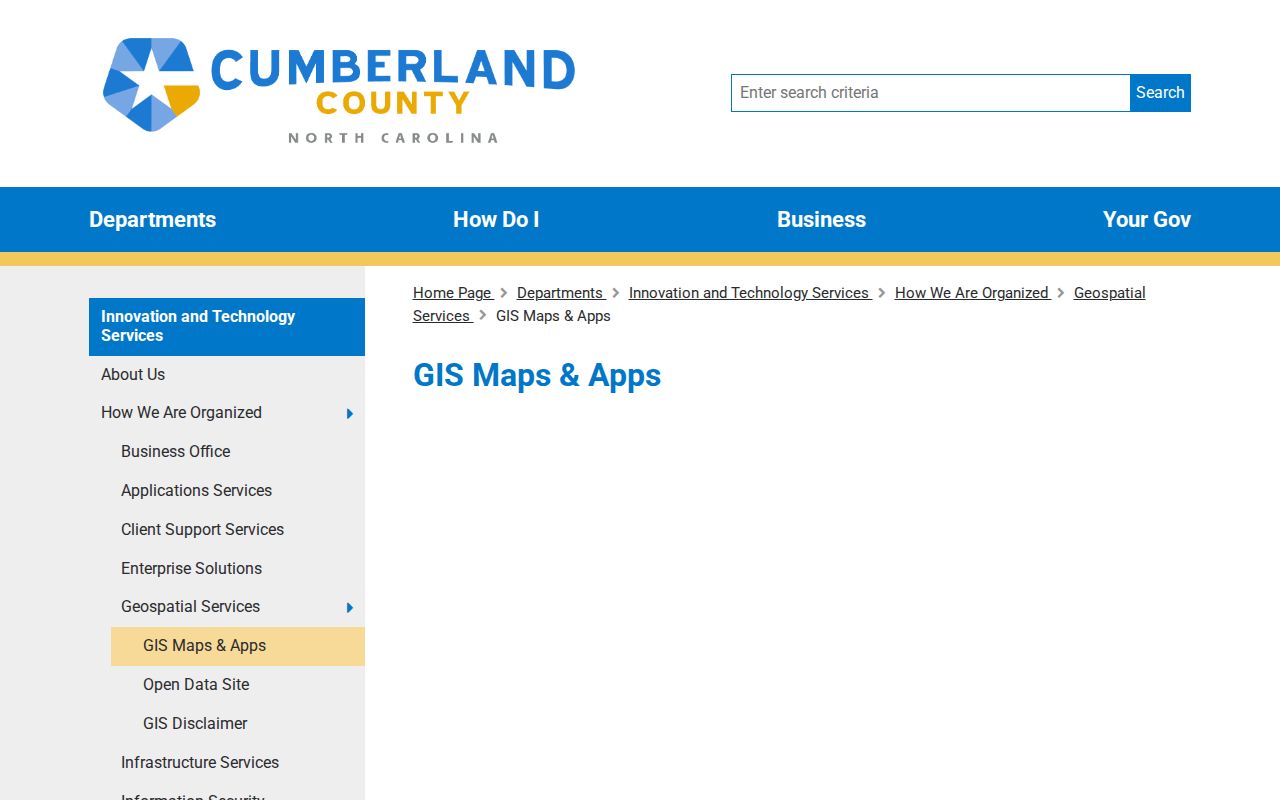
The gateway helps route an address to mapped county evidence before the requester chooses a city or county custodian. A Fayetteville mailing address does not, by itself, prove that a parcel lies inside city limits. GIS is also a research aid, not a survey or title opinion.
Fayetteville Court Records Channels
District and Superior Court District 14 serve Fayetteville from the Cumberland County Courthouse. The public N.C. eCourts Portal offers Smart Search, hearing search, and judgment search without requiring an account. Registration can save cases, but it does not unlock sealed or restricted material.
| Portal field | Control | Use in a Cumberland search |
|---|---|---|
| Smart Search | Required text for a basic search | Case number, party or business name, attorney, or other indexed value |
| Location | Optional filter | Select Cumberland to narrow a Fayetteville result set |
| Party name | Optional text criterion | Combine with other fields to separate common names |
| Case type and status | Optional selects | Narrow civil, estate, criminal, or special-proceeding results |
| Filing date range | Optional date pair | Restrict results to the relevant filing period |
| Wildcard | Text syntax | Use at least three last-name letters plus *; first name permits one plus * |
A case summary can show the case number, filing information, status, parties and roles, events, dispositions, hearings, and some financial data. It does not promise every document image. Search the public self-service terminal or ask the Cumberland clerk for the underlying file. A certified single-county criminal search uses Form AOC-CR-314 and costs $25; it is not a statewide certification.
Note: A portal docket is a lead, while the courthouse terminal, local file, and certified copy provide fuller or formal evidence.
Fayetteville Vital Records Access
North Carolina Vital Records keeps statewide birth, death, fetal-death, marriage, and divorce certificates for stated coverage periods. The Cumberland Register of Deeds is often the same-day local route for a qualifying Fayetteville birth, death, or marriage certificate. Divorce judgments and full files come from the Cumberland Clerk, while the state issues a shorter divorce certificate.
Certificate access is record-specific. There is no verified blanket North Carolina rule that opens all births after 100 years and deaths after 50. G.S. 130A-93 makes listed birth identifiers nonpublic and controls issuance along with identity and entitlement rules. A public index fact is not the same as a right to receive a certified copy.
The Cumberland County vital-record information page sets out local certificate routes.
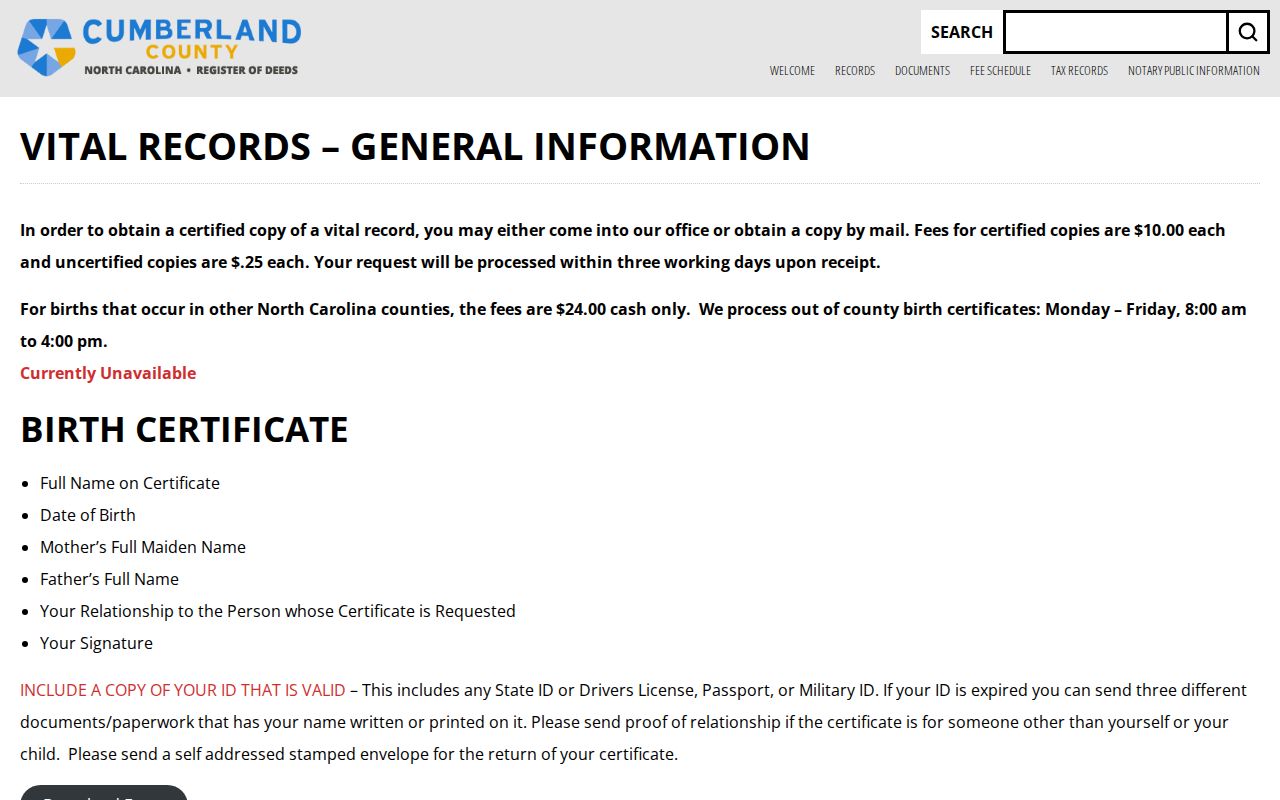
The local screen directs requesters to the proper county certificate service, while the state order route handles statewide searches and specialized records. State orders require record facts, requester contact details, relationship, signature, payment, and legible identity proof. Older material outside modern state coverage can move to county holdings or the State Archives.
Note: For a local death certificate, contact the Register of Deeds in the county where the death occurred, not the county of residence.
Fayetteville Police Records and Kiosks
Fayetteville Police routes crash reports, incident reporting, Event Search, quarterly reports, and records requests through its police pages and P2C. P2C is not a complete list of every crime investigated or reported. It omits material that state law does not permit the department to disclose, and report retrieval requires a date range. A no-result should lead to a focused police request rather than a claim that no event occurred.
In July 2025, the department opened NextRequest kiosks at Campbellton headquarters, Central District, and Cross Creek District. They are available from 8 a.m. to 5 p.m. on weekdays for people who need an in-person way to submit a request. Printed directions and Records Division help are available. The department says a confirmation email comes within 48 business hours, followed by a due date of up to 30 business days through NextRequest.
City administrative requests use Fayetteville NextRequest. Identify the department, subject, staff member or project address, and approximate date span. Utility-authority records belong to Fayetteville Public Works Commission, while county administrative files use the county's separate request portal.
Fayetteville Custody and Registry Records
Custody systems have firm scope boundaries. The North Carolina Department of Adult Correction search covers state prison offenders, probationers, and parolees by name or offender ID. It does not hold Cumberland County jail records. The research did not find a stable official local roster form, so present local custody questions should go through the Cumberland County Sheriff's official channel and be checked against the local court file.
The North Carolina State Bureau of Investigation maintains the statutory registry for registered offenders. Its search supports public name, address, and map routes, but the result concerns registry status rather than a full criminal history. Updates can lag, and absence means only that the search did not return a registered person under the terms used.
The official North Carolina registry search exposes the state search interface.
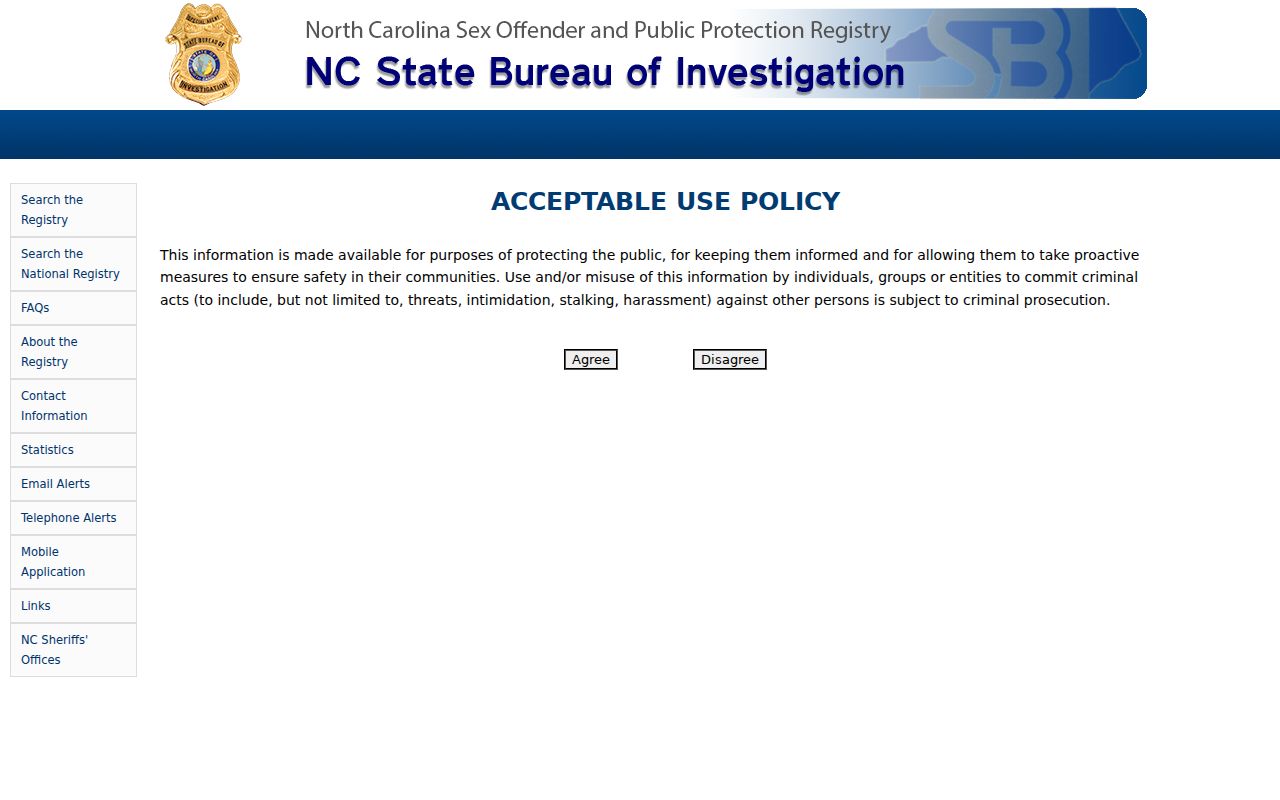
The search is designed for lawful safety information. Verify any match against the source record and relevant court file, and never contact or confront someone based only on a result.
Fayetteville Records Fees and Copies
Chapter 132 generally limits an ordinary copy fee to direct reproduction cost, without routine labor or overhead. A reasonable special service charge may apply when a request needs extensive technology resources or clerical or supervisory help. The agency must base that charge on actual cost and provide an estimate. Certification fees can be set separately by statute.
Fayetteville does not charge for less than four hours of city staff or IT collection time. Each hour beyond four is billed at the current Office Assistant II compensation rate, capped at $750. Half the estimate is prepaid, with the balance due before release. Redaction time is excluded. City paper rates vary by color, side count, and size, while a CD or DVD costs $1.
The Cumberland Register charges $0.25 per page for an uncertified land copy. A certified land copy costs $5 for the first page and $2 for each added page, and plat copies range from $0.25 to $4 by size. These are copy prices, not recording fees. State vital-record searches and court certifications have their own schedules, so request the exact total before ordering.
Closed and Redacted Fayetteville Records
An exemption is a law that closes a record or field that would otherwise fall within the broad public-record definition. North Carolina protects Social Security and account numbers, specified birth data, Address Confidentiality Program information, and many criminal-investigation details. Juvenile, adoption, sealed, and expunged court matters follow their own limits. Motor-vehicle personal data are also governed by the federal Driver's Privacy Protection Act.
The state's Address Confidentiality Program gives qualifying relocated victims a substitute address and mail forwarding. Agencies generally accept that address for a new record when a participant presents a current authorization card, subject to statutory exceptions. The actual address and telephone number are nonpublic under G.S. 132-1.1(d). That protection does not automatically erase older deeds, tax listings, or court files because each custodian applies its own statute.
Ask for segregable material when only part of a file is confidential. A protected identifier can be redacted while open transaction facts remain available. Likewise, a missing eCourts or police result does not prove that a sealed, restricted, or older record never existed.
Request Fayetteville Public Records
A request works best when it seeks an existing record from the office that made or keeps it. Use an indexed document number where possible. Deeds need an instrument or book/page. Court files need a case number, party, document title, and filing date. City records benefit from a department, subject, address or project, staff name, and narrow date span.
- Name the custodian. Separate city, county, state, and court material before sending the request.
- Check the purpose-built index. Save the parcel ID, book/page, case number, or other stable key, even when the online summary is enough to start.
- Describe the existing record. Give a focused subject, record type, people or address involved, date span, and preferred electronic format.
- Confirm cost and delivery. Ask for an estimate before paid work, choose plain or certified copies, and request rolling production for a large set.
- Address a denial. Ask for the cited exemption, request nonexempt portions, narrow the scope if useful, and consider the Chapter 132 remedies.
Online submission is convenient, but it is not the only route. The Register accepts counter and mail requests. The clerk provides public terminals and local-file access. Police kiosks help with digital city requests. Historical files may require the courthouse, State Archives catalog, or local-history collection after an online index ends.
Lawful use. Open access does not permit threats, tracking, impersonation, or repeated unwanted contact. North Carolina stalking and cyberstalking laws can apply to how information is used after a lawful inspection.