
Fayetteville Directory Landscape
Fayetteville people directories fall into three useful groups. Current institutional rosters connect a name with a public office, school, or university. Record indexes list a person because of a deed, tax parcel, voter registration, business filing, or license. Historical volumes freeze names, addresses, spouses, and occupations at a stated publication date. These sources should not be blended into one supposed current profile. A staff roster shows a public role, while a deed index shows a party to a land instrument.
| Fayetteville directory | Names represented | Source keeper | How to browse |
|---|---|---|---|
| City department rosters | Named staff, titles, work phones, emails | City of Fayetteville | Free department browse |
| Cumberland County Schools | Principals and school-level staff | School district | Free school and staff pages |
| Fayetteville State campus route | Faculty, staff, offices | Fayetteville State University | Free office index and directory link |
| Tax, deed, and voter indexes | Owners, transfer parties, registered voters | County and state agencies | Free online indexes |
| Official license and business searches | Licensees, agents, company officials | State boards and Secretary of State | Free board-specific searches |
| Digitized city directories | Past residents, spouses, firms, addresses | DigitalNC | Free page-image volumes |
Choose by relationship. A city question belongs in department rosters. A teacher or principal belongs in the district browse path. An owner name starts in the county tax roll, while a past occupant may appear in a street section of a dated city directory. For genealogy, the verified printed editions and archive series carry more weight than an undated name result. Every entry needs a source date and context.
Fayetteville City Staff Directory
Fayetteville does not publish one verified citywide name-search form. Its working directory is spread across the City Departments index and staff tables maintained by each unit. Pick the office first, then browse its roster or use the browser’s Find command for a surname or title. Finance, for example, displays staff in surname-first form with role, direct work phone, and linked city email. A vacant slot can appear in the name column because the table also tracks positions.
| Directory control | Control type | Required | Practical use |
|---|---|---|---|
| City Departments index | Alphabetical and category browse | No | Open the unit most likely to hold the role |
| Department staff links | Page links and tables | No | Review names, titles, phones, and emails |
| Browser Find | On-page text search | No | Try a surname or public title within one unit |
A sample Finance directory entry is compact and work-focused. Its visible inventory includes:
- Staff name in surname-first display
- Public role or department title
- Direct 910 work telephone number
- Linked city-government email address
The City Council roster separately identifies the mayor and council members with districts and contact routes. Cumberland County publishes office contacts, while North Carolina maintains a state employee directory for agency contacts. If a city name is absent, call the department’s main line or route a focused request through the city records channel. Department pages vary, and no result from one page is not proof that the person has no public city role.
The official Fayetteville department directory shows how the city routes a directory search through individual departments.
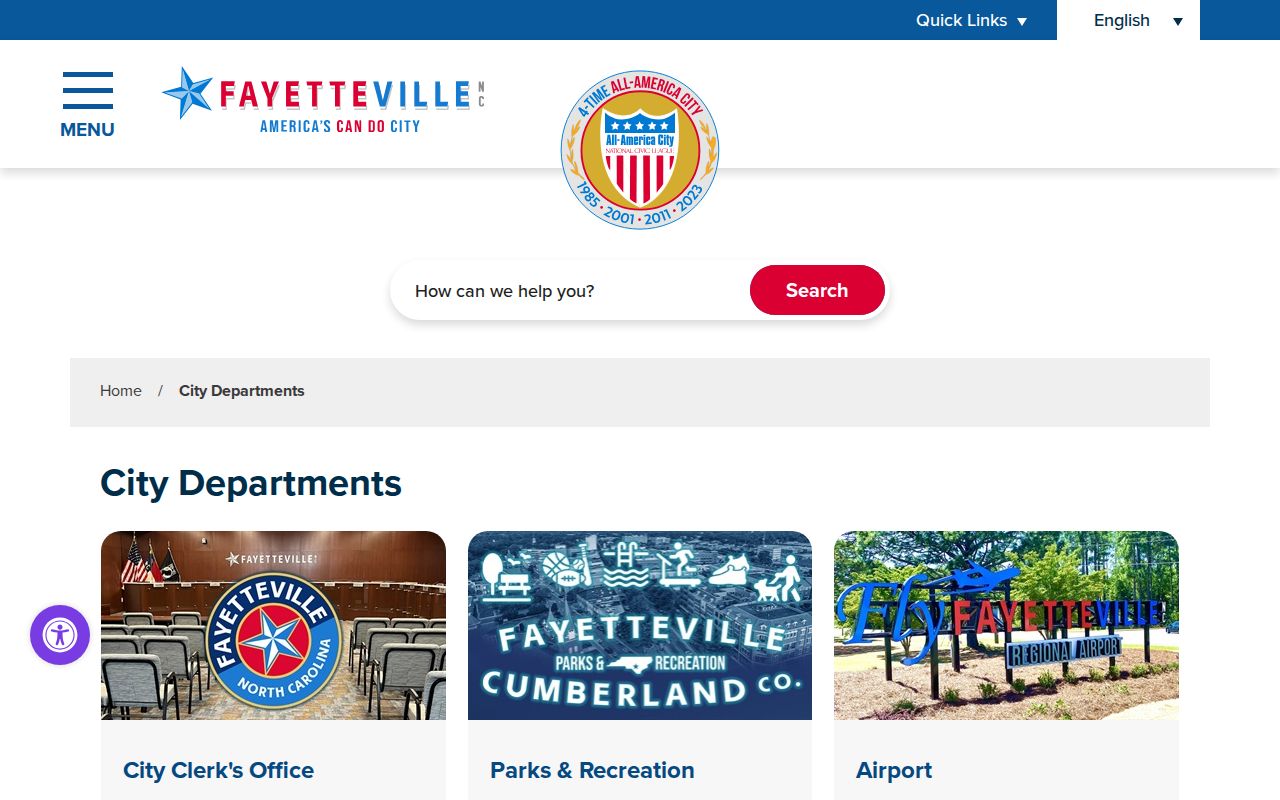
The department-first layout explains why a known unit or function is often a better starting point than a name alone.
Fayetteville School Directory Routes
The Cumberland County Schools directory is the richest verified education route in Fayetteville. Its district table begins with the institution, not a staff surname. A school entry can show the school name and number, grade span or program note, street address, main phone and fax, principal, and a link to the school site. Open that site’s Staff page for person-level entries.
A school roster can show a portrait, full name, category, role or subject, district email, and sometimes a telephone number. Categories observed in the local sample include administration, office staff, support staff, Exceptional Students, and grade-level groups. The school footer supplies the campus name, address, and main number, which helps separate people with similar names. These are public institutional contacts, not home details, and the listing should be dated to the day it was checked.
Fayetteville College Directory Trails
Fayetteville State University’s divisions, departments, and offices index links its Campus Directory and routes users to academic and administrative units. The directory application did not expose stable field labels during research, so claims about exact first-name, last-name, or department filters would be guesswork. Browse the known unit or use the campus directory link without assuming every past affiliate remains listed.
Historical campus sources can extend a current directory. University publications and yearbooks may preserve students, faculty, and staff after a live roster changes. Methodist University also publishes an official faculty and staff recognition list covering 1980 through 2025 with gaps. That long-run list can corroborate a person’s affiliation and era, but it is not a full institutional roster. Authentication-restricted alumni directories should be treated as private rather than described as open people directories.
Note: A current campus roster and a historical yearbook answer different time-based questions, so record the source date with every affiliation.
Fayetteville Public Record Directories
Several Fayetteville indexes function like directories because they organize names by a legal relationship. The Cumberland County tax roll lists the owner recorded for tax purposes as of January 1. Its prior-year portal accepts bill number, parcel number, owner name, or street name. That owner listing is not a title opinion, and it may lag a recent deed or estate event. The deed index instead lists grantors and grantees, meaning parties transferring an interest, with filing date and book/page references.
The county’s land index reaches online to 1754, an unusually deep name trail. That number describes record coverage, not the date scanning began and not a promise that every image or note is online. The Register of Deeds search gateway is name-indexed, so an address-first question should begin with Tax Administration and GIS. Resolve the listed owner or parcel, then carry the exact name into deeds. Voter files form a third directory layer, recording registration details rather than ownership or occupancy.
Each list answers a narrow question. Tax data identifies an assessed owner at a set date. A deed names parties to an instrument. A voter entry reflects registration. None, by itself, proves current residence. The broader access rules and copy channels belong with Fayetteville public records.
Fayetteville Professional Directories
North Carolina has no single official directory for every credential. Board-specific searches cover physicians, nurses, lawyers, real estate brokers, general and electrical contractors, cosmetology professionals, engineers, surveyors, pharmacists, and pharmacies. Start with a surname, firm name, or license number. Read status and expiration fields closely because a historical or inactive credential is not the same as a current one. Linked board orders are stronger evidence than a short result summary.
The Secretary of State business registry adds business names, registered agents, and company officials. Its search target can be Business Name, Registered Agent, or Company Official, with match choices such as exact, starting with, all words, any words, and Soundex. An entity result may show the legal name, SOSID, status, formation details, agent and office addresses, officials, and filed reports. Filing history can reveal earlier names or agents.
Cumberland County also keeps assumed-business-name certificates, indexed through the statewide assumed-name search. Electronic filing began in September 2025, a local access change, though a convenience fee applies to filing. Treat a business filing as evidence of a stated role and date. A similar trade name alone can join two unrelated firms.
Note: Match a business through its SOSID, filing history, and agent rather than relying on a similar Fayetteville trade name alone.
Historical Fayetteville Directory Editions
Two exact Fayetteville editions were verified in DigitalNC. The 1915-16 Fayetteville city directory contains an alphabetical resident and business sequence plus city information. Hill’s 1951 Fayetteville directory supplies another dated snapshot. Typical entries join a name or initials with spouse notation, occupation or firm, and a residence or business address; the later volume can also include a telephone number.
| 1754 | Cumberland County’s verified archival deed series begins, creating an early name-and-land trail. |
|---|---|
| 1915-16 | A full Fayetteville directory scan provides alphabetical residents, firms, addresses, and city context. |
| 1951 | Hill’s edition links residents, spouses, occupations, addresses, and some telephone details. |
| Today | Current rosters and record portals add institutional roles, parcels, filings, and registrations. |
The two digitized editions are anchor years, not proof of a complete annual run. No authoritative itemized shelf list for every local phone book, reverse directory, newspaper reel, obituary index, or yearbook was verified. Cite the exact edition and page. OCR, or optical character recognition, can misread old type, so browse the relevant letter pages when a text search fails. Try initials, a spouse’s first name, and spelling without punctuation.
Reverse Fayetteville Directory Research
A reverse directory starts with a street address and returns the listed occupant. In older Fayetteville volumes, the street sequence can bridge an address to a household when the alphabetical section is hard to search. It still records publication-time listing, not property ownership. Once a name appears, compare it with the census, tax roll, deed index, newspaper notices, or an estate file from the same period.
- Alphabetical directory
- Resident or business names arranged by surname or firm name, often with an address and brief occupation.
- Reverse directory
- Street names and house numbers arranged to show the listed occupant at an address.
- Listed owner
- The person or entity carried on the county tax roll for a stated date, which may differ from an occupant.
- Book and page
- The stable reference used to locate a recorded deed or related land instrument.
Fayetteville’s long military ties make dates especially important. People may move on post, off post, or out of the area within a short interval. A missing name in one edition is weak negative evidence. Search the installation name used during the relevant period, and never infer a military tie from a Fayetteville address alone.
Fayetteville Archives Beyond Directories
Printed people directories become more useful when paired with archives. The Cumberland County library genealogy gateway points toward local-history research, though exact shelf-year coverage was not verified. The State Archives of North Carolina holds county record series and manuscript collections. Search its catalog by surname, organization, place, and record group, then request the cited series or box.
Yearbooks and campus publications are strong leads for reconnecting with a classmate or placing a relative at a school. Newspaper notices may add marriages, deaths, military transfers, and legal events. Cemetery and veterans’ grave records can provide another dated identity check. No complete official Fayetteville obituary index, public congregation roster, union list, or open alumni directory was verified, so those gaps should remain gaps. Private membership lists deserve their access limits.
The city’s older names also matter. Cross Creek and Campbellton or Campbelltown can appear in early deeds, papers, and local histories before Fayetteville became the standard label. The Great Fire of 1831 destroyed more than 600 buildings, but research did not verify a defined span of county record books lost in that event. It would be wrong to turn a city disaster into an unsupported courthouse-loss claim.
Note: Search Cross Creek and both Campbellton spellings when an early Fayetteville name is absent from an archive or newspaper index.
Directory Turnover in Fayetteville
Fayetteville’s location beside Fort Bragg helps explain why directory evidence changes fast. The city reports more than 50,000 active-duty personnel, about 15,000 civilian personnel, and roughly 7,000 soldiers transitioning each year, many of whom remain in the area. Those numbers describe the community, not any one person. They do mean that a one-year gap or a changed address should be checked against records from the same date.
A careful comparison preserves each source’s limits. Government and school rosters place a person in a public institutional role. Property and deed directories connect names to a parcel or transfer. A historical directory ties a listed person to an address and edition. Yearbooks and recognition lists show an affiliation at a particular time. Date-stamping each finding prevents a past contact detail from being mistaken for a current one.