
Find People Through Fayetteville Records
There is no single government database for everyone in Fayetteville. The best starting point depends on what is already known. A name can lead to a court party, a property owner, a voter profile, a business official, or a person named in a deed. An old address calls for a different route through Cumberland County tax and GIS data. Family history often begins with a city directory, an estate file, or a vital-record request. Each source proves only the relationship it records.
Fayetteville is the Cumberland County seat, so many useful records sit with county offices at the courthouse rather than City Hall. City agencies keep municipal permits, council material, police reports, and department correspondence. State systems hold voter profiles, prison records, business registrations, and unclaimed property. Start narrow, save the stable record number that appears, and use that number to verify the same person in the next official system.
- Write down the full name, likely year range, address, or organization that separates the person from similar names.
- Use the Cumberland tax search for an address or owner, and use eCourts for a court party or estate name.
- Carry a parcel number, book and page, case number, SOSID, or voter registration number into the next lookup.
- Open the filed record or ask its custodian for a copy. An index result alone can omit key context.
- Compare dates, middle names, roles, and places before deciding that two results identify the same person.
Note: A common name is not a match until the record’s date, place, role, or stable identifier also fits.
Fayetteville People Search Offices
Three custodians form the core Fayetteville records trail. The Cumberland County Register of Deeds indexes land transfers, deeds of trust, plats, assumed names, and local birth, death, and marriage records. The Clerk of Superior Court holds civil and criminal cases, estates, wills, and special proceedings. City records staff route requests for municipal material through Fayetteville NextRequest. Detailed access rules and copy procedures belong with the Fayetteville public records system, but these contacts help identify the right first desk.
Cumberland Register of Deeds
117 Dick Street, Room 117
Fayetteville, NC 28301
910-678-7775
Clerk of Superior Court
117 Dick Street
Fayetteville, NC 28301
910-475-3000
Fayetteville City Records
433 Hay Street
Fayetteville, NC 28301
Online request route
Tax Administration and GIS also work from the courthouse, in Rooms 530 and 573. They resolve a street address to the listed owner, parcel, mapped boundary, and tax data. The Register cannot conduct that address-first search because its land index is alphabetical by party name.
Fayetteville Property Search Paths
A street address is strongest when it is translated into a parcel. Cumberland County’s current real-estate and GIS gateway identifies the tax-listed owner and mapped land. The prior-year tax portal accepts several direct keys. It can show an owner mailing address that differs from the property, but that difference does not prove where the owner lives. The tax roll also reflects a January 1 listing date, so a recent deed or estate change may appear elsewhere first.
The Cumberland tax search supplies the starting controls shown below. After a bill opens, “Go to Abstract” leads to value information. Save the parcel number and listed owner exactly as shown. Then use the owner name in the deed index and the parcel in GIS. A legal description and book/page reference are better long-term keys than a street label that can change.
| Search control | Best use | Next step |
|---|---|---|
| Bill Number | Known tax bill | Open bill detail |
| Parcel Number | Exact land record | Compare GIS and deed |
| Owner Name | Ownership trail | Search grantor or grantee |
| Street Name | Address-led search | Resolve the parcel |
The official tax interface shows how Fayetteville address research branches into bills, parcels, owners, and streets.
View the Cumberland County tax portal pictured here.
The screen is a finding aid. Confirm ownership with the recorded deed and use historic directories when the question concerns an occupant rather than an owner.
Fayetteville Deed Search Since 1754
Cumberland County says its real-estate records are searchable online back to 1754. That depth creates a rare bridge between a present Fayetteville parcel and colonial-era family land evidence. The index is organized by names, not addresses. A grantor is the person transferring an interest, while a grantee receives it. Both roles matter when tracing the chain across deeds, deeds of trust, satisfactions, plats, and estate transfers.
Online coverage does not mean every page or marginal note is easy to read from home. Search the name in variants, capture the filing date and book/page, and open the recorded image when available. The Room 117 counter, indexing staff, and mail route remain fallbacks. Uncertified land-record copies cost $0.25 per page. Certified copies cost $5 for the first page and $2 for each added page. Those are copy charges, not recording fees.
- Index
- A list that points to the filed record but is not the full instrument.
- Book and page
- The recorded location used to retrieve a deed or related filing.
- Grantor and grantee
- The transferring party and receiving party named in a land instrument.
- Plat
- A recorded map that identifies lots, boundaries, and subdivision details.
Note: “Online to 1754” describes indexed content coverage, not the date scanning began or a promise that every image is remote.
Fayetteville Court Records by Name
Fayetteville cases run through Cumberland County District Court and Superior Court, both in District 14. The statewide eCourts Portal offers anonymous Smart Search, hearing search, and judgment search. A party-name query can be narrowed by Cumberland location, case type, status, and filing dates. Results may show a case number, filing information, parties and roles, events, hearings, dispositions, and financial details when public.
A docket is the indexed sequence of case events. It is not the whole case file and is not a certified exhaustive name search. Restricted categories include sealed material, juvenile cases, unreturned warrants, and several protective-order records. Searchers can use a clerk’s public terminal for broader noncertified access, then ask the local clerk for the underlying file. Older paper files may require advance confirmation.
| Fayetteville court channel | What it identifies | Access route |
|---|---|---|
| District Court District 14 | Criminal, civil, small claims, and family matters within its authority | eCourts, terminal, clerk file |
| Superior Court District 14 | Felony, larger civil, estate, and special-proceeding records | eCourts, terminal, clerk file |
| Federal courts | Federal district, bankruptcy, and appellate parties | PACER account and court file |
The Portal is the fast lead, while the courthouse terminal and Clerk of Superior Court file are the fuller official channels. Compare the county, party role, filing date, and case number before joining a court result to another Fayetteville record.
Fayetteville Vital Records Routes
For an ordinary Fayetteville birth, death, or marriage certificate, the Cumberland County Register of Deeds vital-records desk is often the local route. North Carolina Vital Records holds statewide births from 1913, deaths from 1930, marriages from 1962, divorces from 1958, and fetal deaths from 2001. A divorce judgment comes from the Clerk of Superior Court, while the state office issues a shorter divorce certificate.
North Carolina does not use the generic rule that every birth stays closed for 100 years and every death for 50 years. G.S. 130A-93 controls protected birth data, and certified-copy rules require identity and entitlement. The state offers online or telephone ordering, mail applications, and appointment-only office service. The county counter is a separate fallback for many local events. Older material outside state coverage may require the Register, courthouse holdings, or the State Archives county collections.
| Record | Fayetteville source | Key distinction |
|---|---|---|
| Birth | County Register or state office | Protected identifiers and certified-copy eligibility apply |
| Death | County of death or state office | Use the event county for the local route |
| Marriage | License-issuing county or state office | Give both applicants and place of license |
| Divorce | Clerk for judgment; state for certificate | The certificate is not the full court file |
Fayetteville Search Across City Lines
A Fayetteville postal address does not establish that a parcel sits inside city limits. Cumberland County GIS should settle jurisdiction before any permit or code search. A parcel inside Fayetteville can have project records in E-Development for submissions after 2021 or FayWorx for 2015 through 2021. Missing and older city material goes through NextRequest. Land outside the city follows county planning and inspection channels, while military parcels follow separate federal controls.
This boundary check prevents a common dead end. County offices keep deeds, parcel data, court files, and voter administration for Fayetteville and the surrounding county. City departments keep municipal business. Fayetteville Public Works Commission is a separate public authority with its own records route. An address trail therefore works best as a flow: postal address to GIS parcel, jurisdiction to the correct permit custodian, listed owner to deed index, and old occupant to a dated directory.
Note: ZIP codes and mailing-city labels are delivery geography, not proof of city limits, voting districts, parcel ownership, or permit custody.
Fayetteville Records Kiosks and Requests
Fayetteville uses NextRequest for municipal records that are not already published. A useful request identifies the subject, project or address, likely division or staff member, and date range. Simple matters may finish in days. Large email sets or records needing legal review can take much longer. North Carolina law says records must be produced “as promptly as possible,” not within one universal number of days.
The city charges no staff or information-technology collection fee for the first four hours. Time beyond that is billed at the current Office Assistant II rate, capped at $750, with half the estimate prepaid. Redaction time is excluded. Paper and disc fees have their own posted rates. A focused request lowers the risk of an extensive service charge and gives the custodian a practical record set to locate.
Open the Fayetteville NextRequest portal shown here.
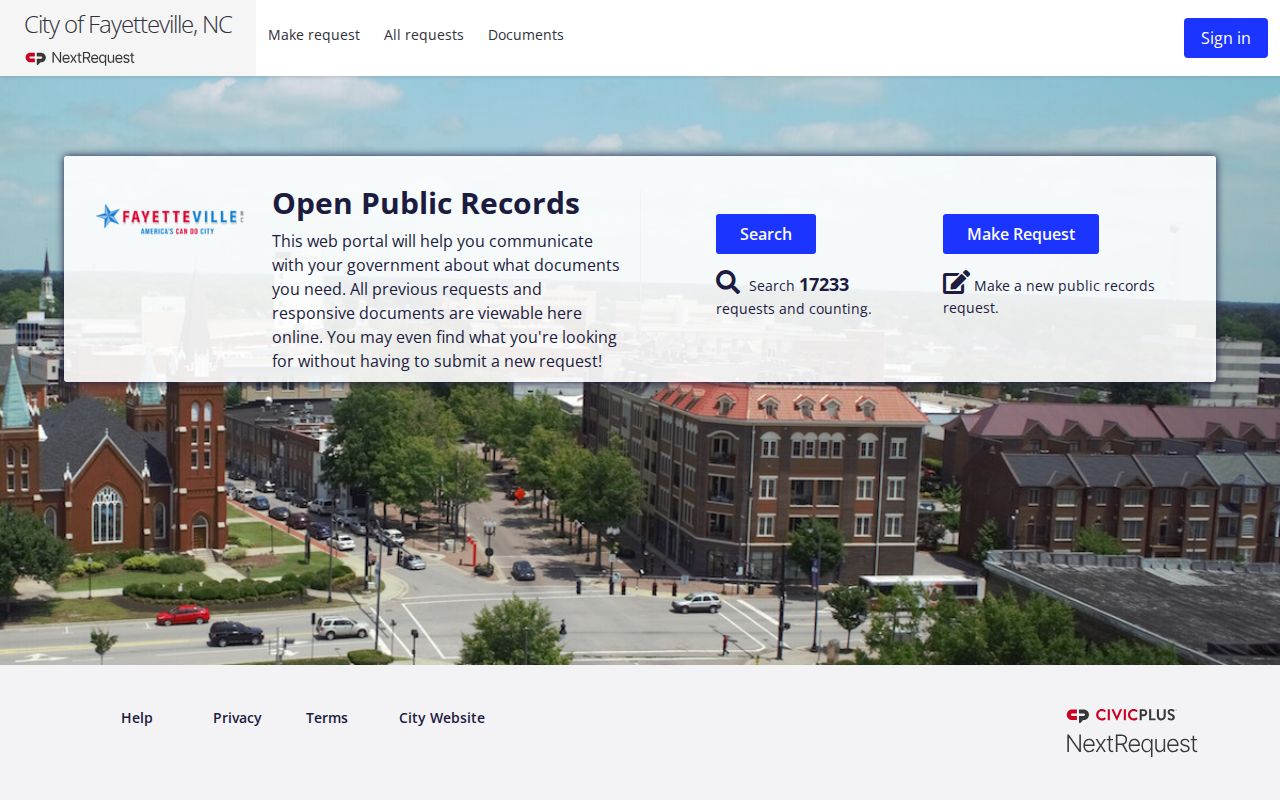
The interface also lets a searcher browse prior released requests. Since July 2025, police records kiosks at Campbellton, Central, and Cross Creek districts have provided an in-person submission option on weekdays.
Fayetteville Offender Search Boundaries
Custody systems answer different questions. The North Carolina Department of Adult Correction locator covers state prison offenders, probationers, and parolees by name or offender ID. It does not cover Cumberland County jail custody. The state Sex Offender Registry covers people who have a registration duty, not every person with a criminal case. Fayetteville Police P2C provides selected event, crash, and report functions but says its public set is incomplete.
No stable official Cumberland County public jail-roster search was verified in the research. For current local custody, start with the official Sheriff’s Office route and compare the name against the court calendar or case file. A missing state-locator result can mean local detention, federal custody, another state, a release outside community supervision, or simply a record outside that system’s scope.
See the official NCDAC offender search form pictured here.
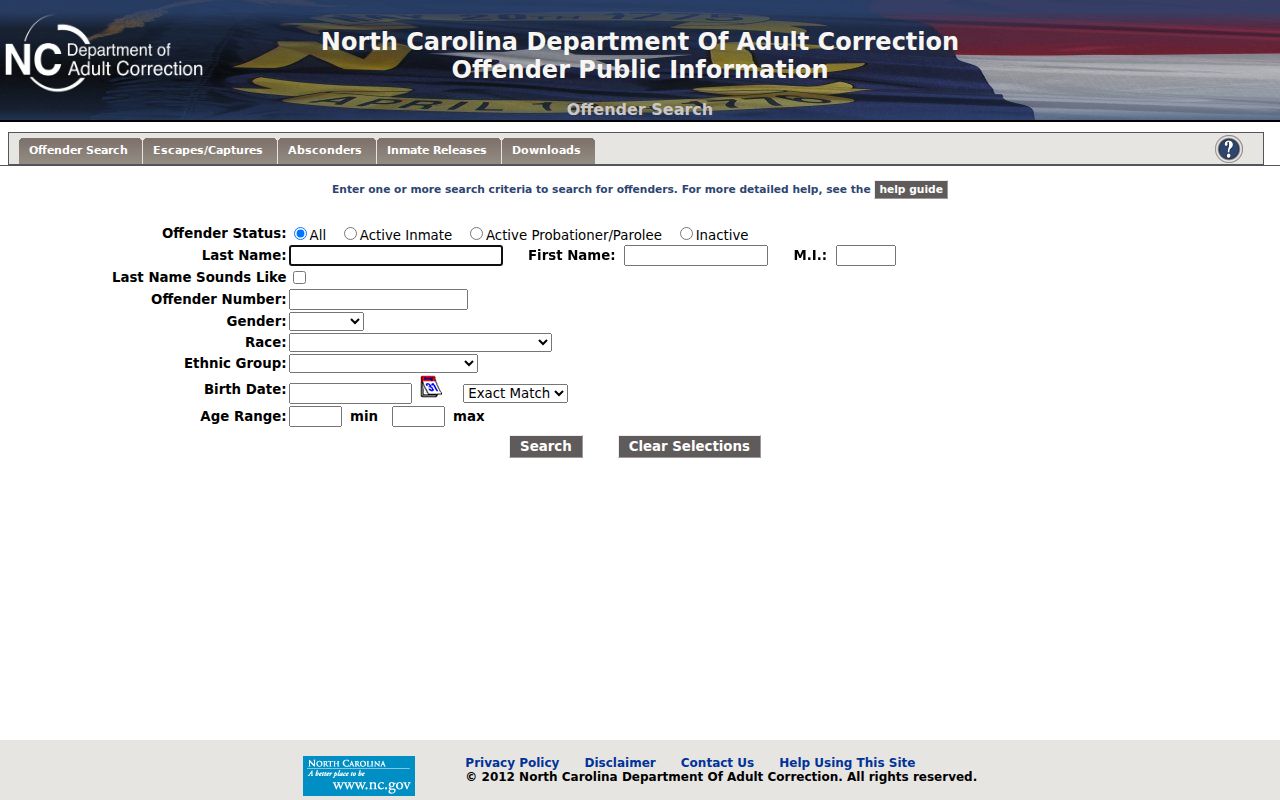
The result should be matched to an offender ID, conviction facts, and dates, then checked against the underlying court record. Use all safety information lawfully and never to threaten or harass anyone.
Fayetteville Business and Unclaimed Searches
The North Carolina Secretary of State business search connects a company name to its legal entity, SOSID, status, registered agent, principal office, company officials, and filed annual reports. Search choices include business name, registered agent, and company official, with exact, starting-with, word, or Soundex options. Cumberland County assumed-name certificates add the local trade-name layer. A business name alone is not enough to merge two entities, so compare the SOSID, filing history, agent, and address.
NC Cash offers a different kind of statewide name search. An unclaimed-property result can preserve a name and location connection after an account, refund, or other property lost contact with its owner. The public search is free, while the claim process requires separate proof. This is a useful reconnecting lead, not proof of a current address or relationship.
View the North Carolina unclaimed-property search shown here.
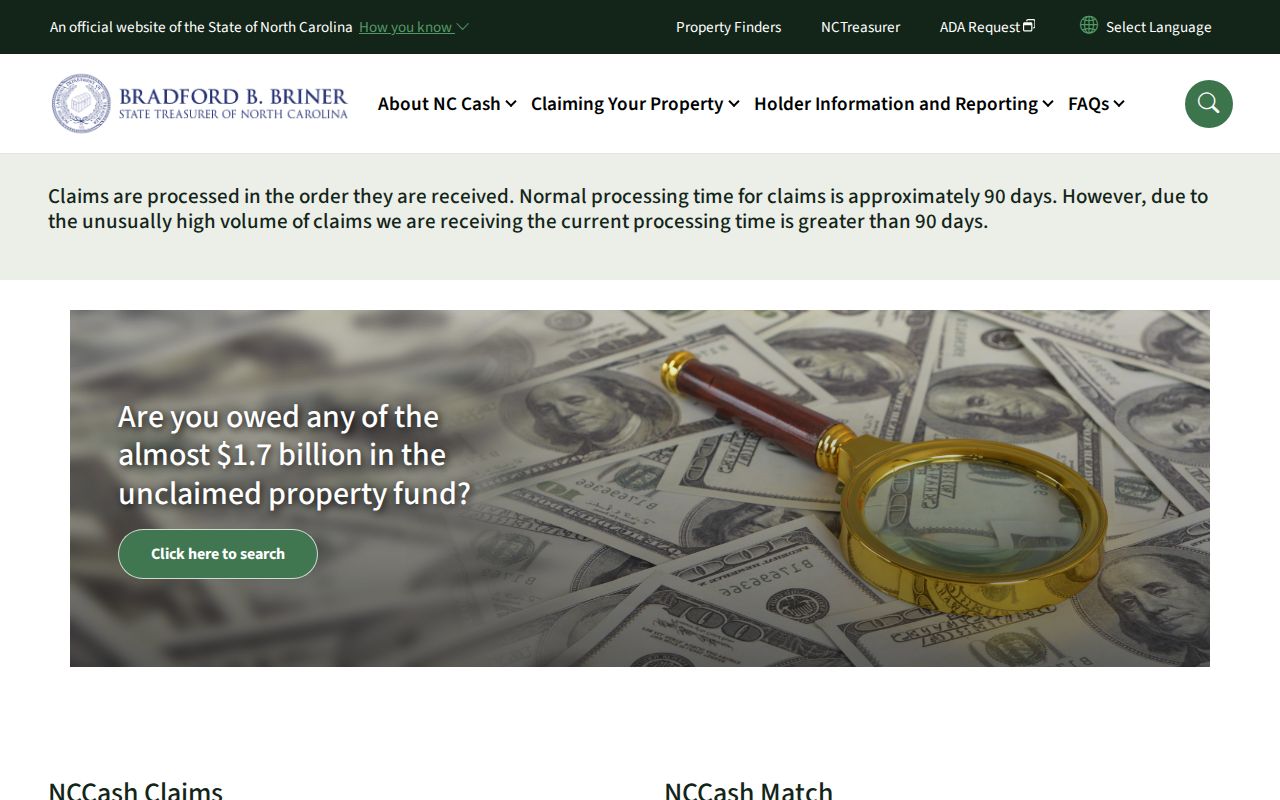
The state page is the official starting point. Be wary of an unsolicited demand for payment merely to reveal a supposed match that can be checked through NC Cash at no charge.
Fayetteville Directory Search Through Time
DigitalNC has verified full scans of Fayetteville city directories for 1915-16 and 1951. The alphabetical pages can connect a surname to an address, spouse notation, occupation, or employer. A street section can reverse the route and identify a listed occupant at an old address. These two editions are anchor years, not proof that every year between them survives online or at the public library.
Search initials, a spouse’s first name, surname variants, and abbreviations when optical text recognition fails. Then browse the letter section by hand. A directory entry reflects a publisher’s snapshot, not legal ownership or a full household count. Confirm the address with a deed, tax roll, census page, obituary, or estate file. This matters in Fayetteville, where military ties and frequent moves can make a one-year absence weak evidence.
The Great Fire of 1831 destroyed more than 600 buildings, and Civil War forces later burned the North Carolina Arsenal. Those events shaped local buildings and private papers, but the inspected official sources do not prove a specific loss of county deed, probate, marriage, or court books. Keep the local story separate from claims about surviving record series.
Fayetteville Search Privacy Limits
Open records still contain protected fields. Chapter 132 withholds specified personal identifiers, and separate laws govern juvenile files, criminal investigations, voter identifiers, motor-vehicle data, adoption material, sealed cases, and vital records. North Carolina’s Address Confidentiality Program supplies a substitute address and mail forwarding for qualifying relocated victims. A protected voter can also use the election-law process to withhold an actual address while other registration facts remain public.
Commercial people-finding products may merge names, keep stale addresses, or hide the source of a result. Official records can also lag or contain mistakes, but they show the custodian and record context needed for verification. The useful distinction is not simply free versus paid. It is an unsourced profile versus a record that can be opened, dated, and checked with the office that keeps it.
Lawful personal use. Public access never permits stalking, threats, repeated unwanted contact, impersonation, or harm. North Carolina stalking and cyberstalking laws apply to conduct after a search.
Reduce false matches by carrying stable identifiers between systems and by respecting a source’s limits. A parcel identifies land, a voter profile records election administration, a docket identifies a case role, and a directory records a dated listing. None of them alone proves where someone lives today.